

Someone Else's Caesar


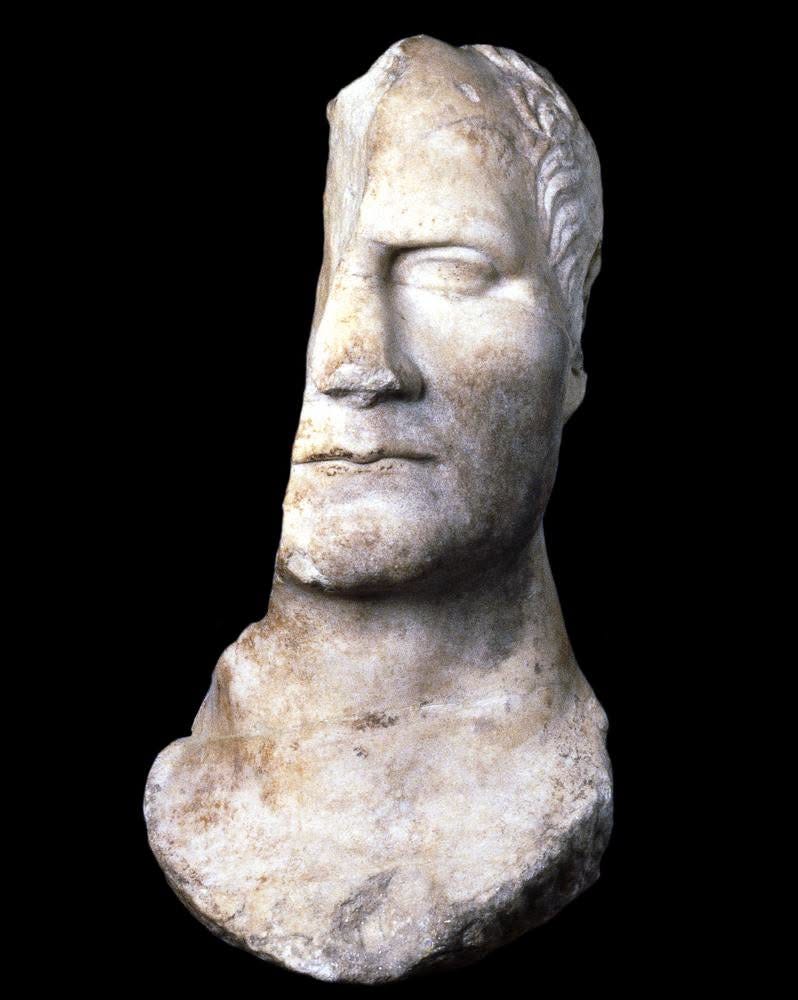
As Julius Caesar was born on July 13th, 100 BC, we have just passed, by a day or so, the 2126th anniversary of his birth. Having said that, it is also possible that he was born on July 12th and, indeed, most ancient sources use this as the day to celebrate, if they were in a celebrating mood, such an occasion. This seems mostly based on the day being passed into law, something mentioned by Macrobius in his Saturnalia (1.12.34). Only Dio (Roman History 47.18.5–6_ gives the date as the 13th, but his reasoning, that: “… the Ludi Apollinares fell on the same day, and they therefore voted that his birthday feast should be celebrated on the previous day, on the ground that there was an oracle of the Sibyl which forbade the holding of a festival on Apollo’s day to any god except Apollo.” seems reasonable enough. This would then have moved the celebration a day forward, or, possibly, given that the Ludi lasted for two weeks, all the way to the 5th.
Of course, Dio doesn’t say “the 13th of July” because Romans didn’t count days in numbers as we do. The days of the week were described by various identifiers, such as whether they were a market day, a holiday or a special day and so on, and then there were set days in the month around which the calendar rotated, such as the nones, the 5th or 7th day, depending on the length of the month, and, infamously, the ides, the middle of the month, either the 13th or, in Caesar’s case, the 15th. Macrobius says Caesar was born 4 days before the ides of Quintilis, as July was known back in the day (with August being Sextilis, which is how SEPTember is the 7th month and so on). But, wait! That would mean the 11th, no? My friend, have you already forgotten about Roman inclusive counting?! So soon!? If one counts backwards like a Roman, one starts with the ides - idus, pridie Idus, a.d. III Id., a.d. IV Id. - So the 12th.
One might reasonably argue that Julius Caesar is the most famous Roman of them all, and almost everyone in the Western world knows the name “Julius Caesar” and recognises his life as central not only to our understanding of Roman history but also to many modern civilisations. But has this always been the case for 2,000 years, or is it the product of 18th/19th century neoclassical Roman revisionism? People have always known about Julius Caesar, but did they always view him the way we do today?
Caesar has been famous for the entire two thousand years, sure, but what he’s been famous for has shifted so dramatically from era to era that the Caesar known to a medieval French poet would be almost unrecognisable to an Enlightenment philosophe, and both would be baffled by what Imperial Roman historians made of him. Whether there’s even a single “Caesar” in Western cultural memory, or whether each generation has simply constructed the version it needed, is probably the central question here.
Let’s start where Caesar’s myth actually begins: the immediate aftermath of his assassination. His killers styled themselves as liberators - Cicero went so far as to call Caesar a tyrant and a parricide of the fatherland (De Officiis 3.82f.) - but the Roman people themselves grieved for him, and honoured him as a god. Octavian understood the power of this better than anyone. He took the name Gaius Julius Caesar Divi Filius, son of the divine, and built his entire early career on it. His legions were Caesar’s veterans. His justification for war against Brutus and Cassius was vengeance for Caesar’s murder. Even the renaming of the month Quintilis to Iulius was an act of the Triumvirs in the aftermath of Philippi, coupling political consolidation with what was either genuine popular reverence or very shrewd exploitation of it.
Once Octavian became Augustus, though, Caesar’s star dimmed as Augustus’ began to shine. Not because he was forgotten, but because Augustus no longer needed him. Augustan literature tells the story rather neatly. Horace drew a direct line between Caesar’s triumvirate with Pompey and Crassus and the origins of civil war (Carmina 2.1.3f.). Virgil depicted Caesar as a bellicose figure - Anchises in the Aeneid beseeches Caesar to lay down his arms (6.834f.) - while casting Caesar’s bitter enemy Cato as a lawgiver (8.670). Augustus had his own cult now, and Caesar was quietly repositioned from founding father to cautionary predecessor.
Imperial historians, however, kept Caesar very much alive. Velleius Paterculus, Appian, and Cassius Dio all gave Caesar disproportionate attention relative to his actual share of the chronological span they were covering; Dio devoted a full tenth of his eighty books of Roman history to Caesar’s career alone, despite that career occupying a comparatively tiny fraction of the thousand years his work encompassed. For Imperial writers, Caesar was the turning point: the man who broke the cycle of aristocratic dysfunction and installed something new. The title Caesar itself, of course, passed to every subsequent emperor, though it’s telling that after the Empire split, the senior rulers took the title Augustus while Caesar was demoted to the rank of sub-emperor.
By the later Empire, Caesar’s centrality had faded further, not into obscurity, but into a kind of rhetorical theatrical backdrop. His achievements became a yardstick against which writers measured the superiority of their own contemporary rulers, and Christianisation had shifted the seminal moment of Roman history from Caesar’s dictatorship to the Empire’s adoption of the faith. But even after the fall of Rome itself, his name survived as a designation of supreme authority: Kaiser in the Holy Roman Empire, Tsar in the Slavic world.
Medieval Caesar, though, is a figure that would raise eyebrows in most modern readers. As the founder of what medieval theologians identified as the fourth great empire of Daniel’s Biblical prophecy (Daniel 2:40–43), Caesar was understood not merely as a historical conqueror but as an instrument of God’s divine plan. He became a model of chivalric virtue, the ideal king, a standard against which living rulers were measured and found wanting. German writers, who saw the Holy Roman Empire as Rome’s direct successor, claimed Caesar as the founder of their own empire from as early as the eleventh century. Archbishop Anno II of Cologne’s Annolied is one such example. English and French writers praised his chivalry. He was redrawn as the perfect medieval hero, though one tempered by his own hubris.
Dante captures the medieval Caesar perfectly. In the Inferno, Caesar sits in Limbo among the virtuous unbaptised (4.123), condemned only by the circumstances of his paganism, not by any moral failing. His assassins Brutus and Cassius, by contrast, are consigned to the very lowest circle of Hell, suffering in the jaws of Satan alongside Judas himself (34.61–67). That is not a culture that saw Caesar as a mere footnote.
The Renaissance turned Caesar into a literary figure as well as a political one. The rediscovery, or more precisely, the reattribution, of the Commentarii as Caesar’s own work made it a staple of Latin education and a key text for the study of pre-Roman Gaul. Writers appropriated the Caesarian model for their own purposes: the poet Giannantonio de Pandoni composed a prose work drawing on the Commentarii as a framework for depicting the contemporary war between Venice and Milan, and Pope Pius II modelled his own autobiographical Commentarii on Caesar’s, casting himself rather explicitly in the Caesarian mould and mapping his own struggles against the enemies of the Papal States onto Caesar’s civil war. Petrarch and Machiavelli, meanwhile, continued to wrestle with the duality that had always shadowed Caesar’s reputation - the enemy of Republican virtue who was simultaneously a praiseworthy genius. The ultimate Good Cop/Bad Cop.
Shakespeare, of course, assumed his audience knew who Caesar was, and by the time we reach the Enlightenment, Caesar had been recast yet again: now as the emblem of the philosopher-king, the benevolent despot who wielded absolute authority to impose necessary social reform. Voltaire, while acknowledging Caesar’s failures, held him up as the ideal of what an educated, martial, cultured monarch could achieve. And when the revolutionary generation turned against the monarchy, Caesar came with them, but as a warning rather than an aspiration. Alexander Hamilton warned repeatedly of a Caesar-like demagogue rising to power in the Federalist Papers, and later deployed the comparison against both Jefferson and Burr in his political writings, calling Burr an “embryo Caesar” and attacking Jefferson as a Caesar hiding behind republican modesty.
Napoleon is the elephant in the room when it comes to nineteenth-century neoclassicism. He modelled himself on Caesar with an explicitness that bordered on cosplay. He was the populist general who seized power from a dysfunctional republic, crowned himself, and reshaped the state in his own image. Sound familiar? The parallel was deliberate and self-conscious, and it meant that for the entire nineteenth century, Caesar was being read through a Napoleonic-shaped lens as much as Napoleon was being read through a Caesarian one. Theodor Mommsen’s enormously influential History of Rome, published in the 1850s, cast Caesar as a singular genius-statesman who transcended the petty squabbling of the late Republic through sheer force of will. Mommsen’s Caesar is unmistakably coloured by the political preoccupations of nineteenth-century European nationalism, and his work did more than perhaps any other single text to shape the popular modern image of Caesar as our Great Man of History.
Mommsen and the Napoleonic cult of Caesar absolutely shaped the version most people carry around in their heads. But what they were doing was adding to a tradition that was already two millennia long. Caesar’s fame is not just a neoclassical invention. It runs, unbroken, from the Temple of the Divine Julius through to Hamilton’s fist-shaking polemics, but each era pulled it in whatever direction suited its purposes. The Caesar we’ve inherited is a palimpsest, and trying to peel back to some “original” layers underneath is probably a fool’s errand, because every layer is someone else’s Caesar.
If you’ve been reading this newsletter for a while, you already know what the paid side looks like: longer, deeper, and occasionally in Latin. The paid articles go out every week, alongside a full translation and reader’s guide to the Historia Augusta, a text so strange and unreliable that it has occupied classicists for a century, and me for a decade, without resolution. If that sounds like your kind of thing, the subscription is $5/month. The link is below.
It’s $5/month (or $50/year), and you’ll also get a free copy of my translation of Suetonius’ Twelve Caesars as a welcome gift.
If this piece was worth your time, a $5 tip on Ko-fi is very welcome!

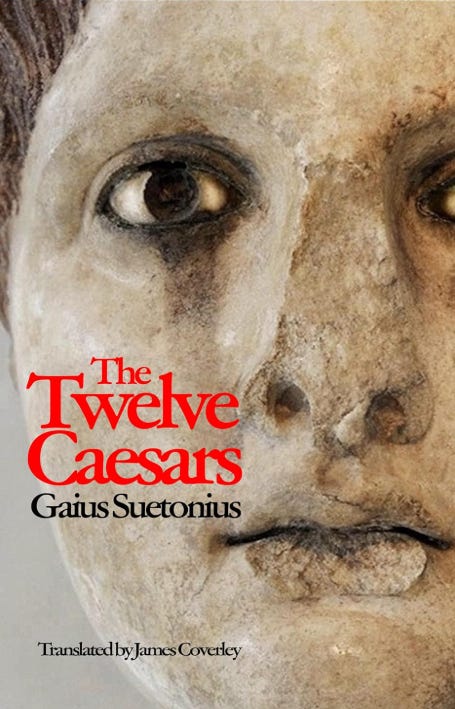
Suetonius is one of the main sources for the Roman emperors, but most modern readers never get through him.
Not because the material is difficult, but because the translations are.
My edition of The Twelve Caesars presents the text in clear modern English, restores what earlier editors removed, and explains the context as you go.
If you want to see what Rome actually looked like from the inside, this is the place to start. CLICK BELOW TO ORDER YOUR COPY!
"Friends, Romans, Countrymen, lend me your ears/I come to bury Caesar, not to praise him..."
We may have remembered Caesar without Shakespeare, but he would have been a more historically distant and unknowable figure otherwise. Shakespeare showed us both his arrogance ("I am as constant as the northern star!)" and his humility in a way that helped us understand the Romans as human beings and not stick figures.
This was superlative. Really opened my eyes, and would have made JC roll over in his grave if he'd been able to.