
Was Jesus Resurrected?



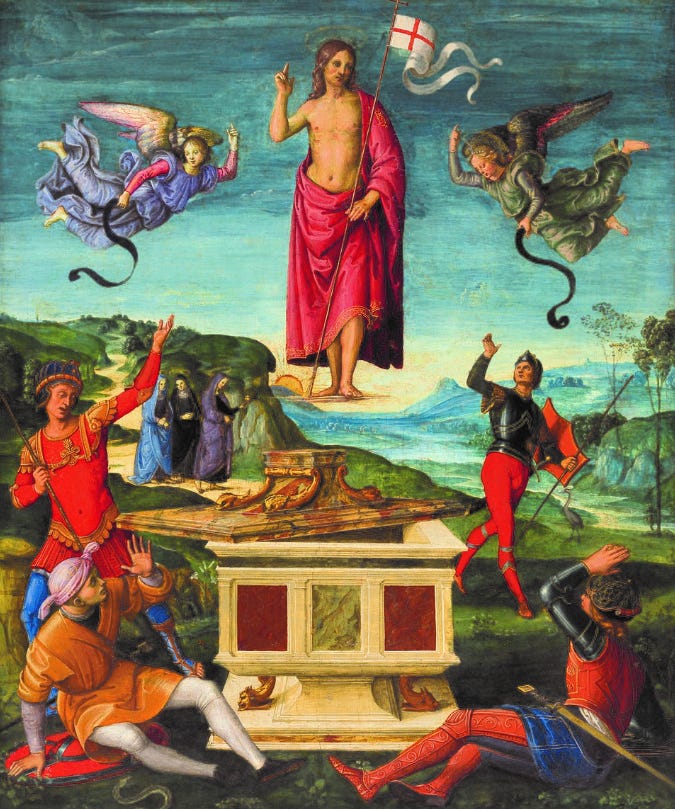
On the evening of the 8th of November, 1910, in Tonypandy in Wales, striking coal miners clashed violently with members of the Glamorgan Constabulary, reinforced by support from Bristol and other areas. One miner, Samuel Rhys, died, and hundreds were injured. The police were further reinforced by the decision of the then Home Secretary, Winston Churchill, to send troops into the area.
Churchill’s decision outraged the Welsh public, and still does. To this day, the name of the man once voted the Greatest Briton of All Time, and who, so it is said, dragged Britain through what he probably rightly called her ‘darkest hour’ in World War Two, is absolute poison in some areas of Wales.
The Welsh forget slowly.
Even to this day, one will see internet memes with Churchill’s terrifying threat:
“If the Welsh are striking over hunger, then we must fill their bellies with lead”
It is, of course, absolute poppycock. He said nothing of the sort. Churchill’s explanation for sending in the troops was as much to control the police, who were a feral gang out for blood, as it was about quelling the strike, although their presence did put a lot of pressure on the strikers to return to work. Either way, Churchill never instructed them to attack the miners, and they didn’t. It was the police who did all the damage, and as we all know, giving badly trained, violent, bloodthirsty maniacs weapons and a badge and turning them loose on your own population is never a good idea.
So, at Tonypandy, Churchill got something of a bad rap and doesn’t really deserve the vitriol for what he did there. Ironically, and sadly, the same cannot be said of the following year, when in the Welsh town of Llanelli, during a strike by railway men, Churchill again sent in the troops. This time, the commander of the Worcestershire Regiment ordered his men to line up, read out the Riot Act to the crowd, and then ordered them to open fire. John ‘Jac’ John and Leonard Worsell were shot dead.
One would think that this would make the assembled crowds go home and lock the doors, but as we have seen, turning the guns of the state on the people just makes those people very angry indeed. What was a peaceful assembly of people wishing for a better life for themselves turned into a day of murder and widespread riot.
Plus ça change and all that.
I grew up a few dozen miles north of Llanelli, in a valley so small that it contained only three houses; ours, a place that belonged to an airline pilot who was never there and the rather grandly named, yet incredibly grotty Park Villa, in which lived two brothers, Eirawyn and Church. Both of them had been born in our house in the early 1920s, and so had moved no further than about 200 yards down the road in their whole life. The name ‘Eirawyn’ in Welsh means, rather fabulously, Snow White or White Snow, depending on how literal you want to be, but quite why Church, short for Churchill, was called that is not entirely clear, particularly given old Winston’s terrible reputation in those parts around the time he was born. Church died in the early 1980s after drunkenly falling, or hurling himself, into the river, and it was only then that we found out his name was actually Ieuan Churchill Lloyd.
Next to Park Villa was the only other building in the valley, Rheoboth Chapel, named after the Biblical city that was home to King Saul of Edom from Genesis. The only other time one would see anyone in the valley, apart from Church going to use the outside privy, newspaper under one arm, was on a Sunday morning when a dozen or so people who wander down the vertiginously inclined road from the top village for some Methodist firebrand, sing-along, doom-laden, warnings.
Watching them file into the big, dour, looming chapel, I had no idea what they were doing or why.
“They’re worshipping God’, my mother explained, and I had no idea what the blazes she was talking about. Worshipping who? What on earth for!? But watching these people, seemingly voluntarily, give up their Sundays to spend time in a building named after some mystical Edomite kingdom fascinated me then and still does. It was the beginning of my love affair with religion. It was not, sadly for my soul, the beginning of my conversion to religion, which I still to this day find mostly agreeable, yet rather improbable. I like it, I just don’t believe in it.
All this waffling is just a way of explaining how, eventually, an atheist from a remote valley in Pembrokeshire ended up in university writing a dissertation on Early Christian Iconography in the Roman Empire, and also goes some way to explainign how what I am poised to entertain you with today is a view of the developement of the New Testament taken entirely from a historical point of view. It is a careful task to unwind the theology from the history of the New Testament, but not an impossible one, so I write the following with the caveat that a theologian, which I am not, will happily come up with a whole other set of exegetical whistles and bells that I will not be covering here.
The question, broadly, then is why did the story of the resurrection of Jesus in the New Testament change subtly over time? Why does Paul, for example, mention the resurrection, but not anything about an empty tomb, whilst other gospels do? Here’s a purely historical explanation:
In the 30s and 40s AD, the earliest followers of Jesus seem to have interpreted their experiences of him after death as real, but not necessarily physical. Paul’s letters show this clearly: he emphasises that Jesus appeared to people, including himself, but he says nothing about empty tombs or anyone touching a body. This suggests that resurrection for Paul and his contemporaries was primarily experiential and spiritual: people had encounters, hallucinations, dreams or visions of Jesus that convinced them he was alive. We all know from our own experiences how ‘real’ such things can be sometimes, no matter how much our rational mind tries to say otherwise. Lots of us have experienced the dream, or similar, where a spider is crawling on us and woken sharply, brushing wildly at the supposed insect, then spent five minutes hunting for the darned thing, only to slowly begin to realise that one imagined the whole thing.
In Paul’s narrative, the “body” was less important than the reality of the person’s continued existence and the vindication of his mission. Judaism at the time allowed for resurrection ideas, but usually in the apocalyptic, collective sense - the righteous would be raised at the end of the world. Jesus’ followers were reinterpreting this concept for a single individual, which was very unusual and an example of why Judaism and the Romans distrusted them so much. This sort of ‘outsider’ thinking was far too radical and punk for the very settled religious hierarchy.
Visionary experiences were a culturally intelligible way of experiencing the divine or the dead. People believed these experiences were real, not hallucinations or metaphors. That doesn’t then mean that these people were sure that a corporeal, flesh-and-blood Jesus was coming to see them, but that the various forms in which he visited them were actual events.
Paul insists that Jesus rose from the dead and visited several hundred witnesses, including himself and Jesus’ brother, James (1 Corinthians, 15:3-8), but his account rolls off the page like a list of people who have seen him, or claim to have seen him, and suggests early belief built on visionary or experiential reports, rather than narrative storytelling.
Paul says nothing about an empty tomb, or the dead body of Christ, or the women who supposedly found the tomb empty. His narrative simply focuses on the existence of a ‘Risen Christ’ who makes visitations to people. The mechanics of the disappearance of the body from the tomb don’t exist in the narrative yet because they are not necessary for what is, at the time, a spiritual resurrection. These early Christians understood resurrection as experiential, visionary, and spiritual, not a bodily fact. Their emphasis is on Jesus being alive in a sense that vindicates him and confirms their faith.
By the time the Gospels are written, say, 70–90 AD, resurrection belief is increasingly framed as physical and tangible. Mark is the first to mention the empty tomb, discovered by the women, including Mary, who go there to anoint the body (Mark 16:1-14). The stone closing the tomb has been rolled away, and a man in a white robe tells the women to tell the disciples that Jesus has risen. Immediately, one can see the difference in the narrative from Paul. This is storytelling that is beginning to build a narrative framework around which the physical resurrection can be built. The empty tomb becomes a storytelling device, but the ‘appearances’ of Jesus are still a mixture of supposed physical manifestations and other visions.
In one case, Mark says that Jesus appeared in ‘other forms’ (Mark 16:12), whereas in 16:14, he appears to the remaining disciples over lunch and has a conversation as they eat. The latter narrative is very physical, and the earlier one much more visionary, all within the space of two verses.
Matthew repeats the story of the women, the rolled stone and empty tomb, only this time the chap in the white robe is now an angel. The women flee from the tomb in a mixture of panic and joy, and suddenly Jesus appears to them (Matthew 28:9). They fall to their knees and clasp his feet, so now the narrative has confirmed that this version of the Risen Christ, at least, is physical. He has actually come back to life.
When we come to Luke, the narrative is broadly the same, but when Jesus pops over for a spot of lunch with the disciples, he breaks bread with them, so now he is even eating (Luke 24:30). Now it is undeniable that this Jesus is 100% a real physical person again.
So the narrative begins with an apparent understanding that the resurrection is spiritual, or at least it is framed in a way that doesn’t express the resurrection in physical terms. That the ‘mission’ has been completed by the resurrection of the spirit is all that matters. Mark begins to add narrative elements to the story, and then Matthew and Luke flesh that out with, well, flesh. A fully resurrected Jesus and an exciting narrative with angels and gasping women fleeing in panic, and all the whistles and bells of a cracking story.
The question is why? It’s tempting sometimes to think of the Gospels as the work of an author or authors because we have attached names to them and can then imagine some bearded chap sitting at a scroll, writing it all down. But these narratives are more complicated than that and come from different sources with different oral traditions, which are then ‘compiled’ (for want of a better word) for different audiences.
Early Christians interpreted Jesus’ death and resurrection through Jewish scripture (Isaiah 53), which emphasises spiritual resurrection. As a result, people like Paul can only really frame resurrection in spiritual terms, and the idea of actually coming back to life is not necessary. Later, a bodily resurrection begins to fit prophetic expectations: God vindicates the resurrection of Jesus physically, not just spiritually. The early followers believed Jesus’ death was unjust and expected divine vindication. Jesus is still expected to make the transformation into the Risen Christ, as per the narrative, but they expect a wrong to be righted as well.
By the time of the later Gospels, the narratives begin to line up with prophecy, so they added physicality and tomb narratives. Whereas Paul doesn’t focus heavily on earlier scripture, as the narratives develop, they begin to align more with the prophecies and so gain storytelling devices that begin to anchor the resurrection in the actual world as well as the spiritual one.
Again, this is not necessarily a case of the bearded author trying to wrangle a good story out of everything so all the metaphorical ducks are in a row. It’s more organic than that. Early Christian communities shared visionary experiences. Over the decades, oral tradition shaped these experiences into stories with more concrete, repeatable elements. Physical resurrection stories served pedagogical purposes: they could be told, visualised, and passed down, making the belief accessible to new believers. It’s much easier to explain to another party that a person came back to life than to try to explain how they entered a ‘spiritual dimension’. Concepts of the spiritual resurrection of Christ can be explained later, once the new believer has been converted. Adding tangible elements (empty tomb, angels, wailing women, eating lunch) gives the narrative social credibility and makes the story more persuasive. Everyone can imagine having lunch, everyone’s seen weeping mourners at a funeral and angels must be really terrifying!
In later decades, going into the second century, Christianity was emerging as its own religion and competing with several Jewish sects and emerging Greco-Roman religious cults. Having a bodily resurrection demonstrated that Jesus really overcame death, not just “in people’s minds.” Physicality countered claims that resurrection was merely visionary or symbolic, giving Christians a much stronger argument.
Therefore, if anyone doubts that Jesus came back from the dead, one can put aside the claim that he appeared in ‘other forms’, and instead insist that his own mother saw the empty tomb, a terrifying angel told them he was alive again, and one actually had lunch with him the other day.
I know I haven’t really answered the deliberately click-baity question (I have to make a living, you know!), but it seems to me that it’s a question for science or theology, not history, and I am not qualified in either of those particular fields.
If tipping is your thing, your help covers research time, editing, and the occasional midnight cheese sandwich that fuels these posts. Thank you for keeping this space alive! Just click below to leave a tip

Paid subscribers get Acta Populi every Thursday, my private dispatch with behind-the-scenes research notes, archaeological finds, and the odd article even I wouldn’t dare put here. It’s $5/5/month or $50/year, and it also comes with my full translation of Suetonius’ Twelve Caesars as a welcome gift.
Join Acta Populi here
Since today’s article quoted directly from my book, you might want the whole thing: my complete translation of Suetonius’ The Twelve Caesars, two years of work, scandal and all. You can grab a copy on its own, or get it free as part of Acta Populi.
Okay- no quoting or mentioning Sir Winston if I get to Wales...
Great writing! Very interesting. As an atheist anything that is obviously unphysical, unworldly and immaterial does not rise to the level of proof. But this does to get to the question of why. Maybe now you can do an essay on how Catholics are cannibals and pagans, just for clarification.