
What Was Apotheosis?


In July of 69 AD, Vespasian was declared emperor by the legions in the east. Now you might think this is a cause for great celebration, and it was, but there was one problem, and that problem went by the name of Vitellius, who, not unreasonably, given he had the support of the senate and was sitting in Rome eating dormice, tended to think that he was still emperor, thanks very much, and had no intention of that situation changing in the near future.
Vespasian had other ideas about that, of course, and the aforementioned legions on his side. Vitellius had a rag-tag collection of legions of dubious loyalty, the approval of a senate who just wanted a quiet life and didn’t really care who was emperor as long as they personally didn’t end up in the Tiber, and a plate full of dormice.
Vespasian was soon to gain power absolutely, by rather sneakily sending ahead an advanced army under the command of the ever loyal Marcus Antonius Primus, who met Vitellius’ forces at the second battle of Bedriacum that year and defeated them. That way, when Vespasian wandered over to take power the following year, he could boast that he did so without shedding any Roman blood. Primus shed all the blood, not him. Primus’ reward was a short spell as consul and then historical oblivion, shifted aside as a scapegoat for the carnage and off somewhere where he couldn’t cause any trouble with his obvious ability to have his men wipe out other legions.
Later in 69, Vespasian was in Alexandria when his advisers decided that if the boss was going to reign effectively as emperor, he’d better begin the journey towards becoming a god. The ability to channel divine power was a handy trait for an emperor to have, particularly one who would have their legacy cemented with divine status after death. It also went some way to helping with the idea of the emperor as a figure that should be worshipped in his own right. If the people knew that he could perform the odd miracle or two, then not only would his legitimacy as emperor be seen to be confirmed by the gods, but he could begin the process of transitioning from the mortal realm into the divine one.
So it was that Vespasian found himself cajoled into the temple of Serapis in the city where, quite by chance, you understand, two beggars, one blind and one with a crippled hand, just so happened to be waiting. Tacitus describes them as ‘well known’ (Histories, 4.81), which suggests that some suitably afflicted subjects weren’t hard to find and perhaps, even, that this wasn’t the first time someone was about to perform a miracle on them.
Grovelling before the emperor, no doubt with practised care, they begged him to intervene and heal them, to which Vespasian, who hadn’t quite twigged what was going on yet, promptly told them to get lost. But wait a minute, intervened his advisors, surely one should at least try and heal them, after all, there was a crowd gathered who in no way had been paid to turn up and watch what was about to happen. Vespasian again insisted he wasn’t interested in all this nonsense and he had other, more important, things to do.
But what if the crowd were to think one was a failure, suggested the courtiers? Surely he should at least think about it? Vespasian, ever the pragmatist, thought about this for a moment and, perhaps, began to understand what was going on. We should call for the doctors, he craftily suggested, at which the courtiers hurriedly replied that they had already been seen, and whilst the blindness wasn’t total, and the damage to the man’s hand not irreparable - conspiratorial wink - there was nothing the doctors could do. Perhaps, then, the newly minted emperor might try asking Serapis, the local god whom this assembled crowd were very fond of, if he might intervene to grant Vespasian the power to heal them?
Perhaps, they suggested, the reason he was here today was that it was the will of Serapis that he do something?
nudge nudge
And so Vespasian, finally cottoning on, took a little of his own spittle and rubbed it on the cheek of the blind man, who ran around, weeping in joy, suddenly able to see again, and rubbed the hand of the crippled man, who regained his strength with a whoop of joy, both of them, hopping off in the direction of the nearest tavern, their coin purses suitbaly stuffed, healed of their intolerable suffering for at least another day.
The crowd cheered, Vespasian grimaced, and everyone then went around safe in the knowledge that they had just witnessed a miracle and, more to the point, because someone had witnessed it, and someone else had written it down, how could it not be true?
The more sceptical among you, and those who approach the New Testament purely through a historical lens, might look at this episode and see parallels with some of the miracles performed by Jesus. They happen before a crowd, which legitimises them; someone writes them down in a big old book, which sets them in a historical narrative, and the process is remarkably similar. In Mark 8.23, Jesus heals a blind man with spittle, and saliva had a reputation in Greco-Roman and Near Eastern medicine as having curative power. Therefore, healing in such a way might not in itself be seen as a divine intervention; it might simply be seen as a medical process. The divine intervention in the case of Vespasian is in the setting and the apparently divinely ordered meeting of the sick men and the emperor. In the case of Jesus, his skill as a healer might have had an earthly explanation, but as everything he did is channelled through the narrative of man as God, his natural remedy is divinely inspired and, thus, seen as a miracle just because it was Jesus performing it. A theologian would explain this in other terms, of course.
In both cases, what we are seeing is the construction of a narrative where both men are beginning a process whereby they will become divine spirits upon death - Jesus as the Risen Christ and Vespasian taking his place among the gods, even though, famously, he had no interest in any of that sort of thing.
“Oh no, I’m becoming a god” were not Vespasian’s last words, as is often quoted, but he said them as he realised what was about to happen on his deathbed. His actual last words, as he struggled to his feet, were ‘An Emperor ought to die standing’ (Suetonius, Vespasian, 24)
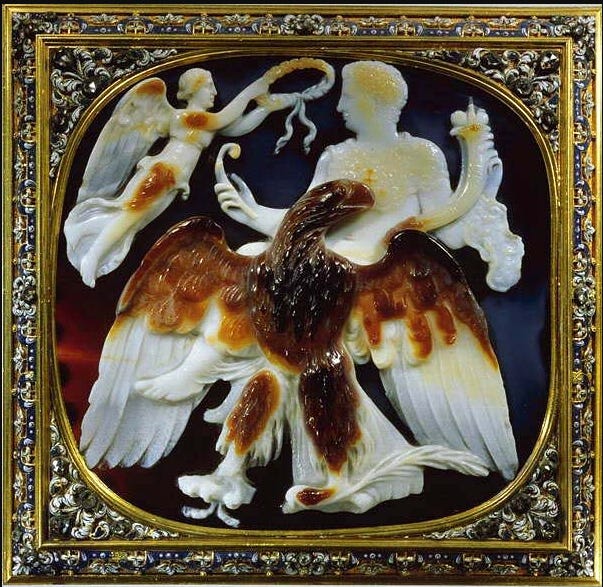
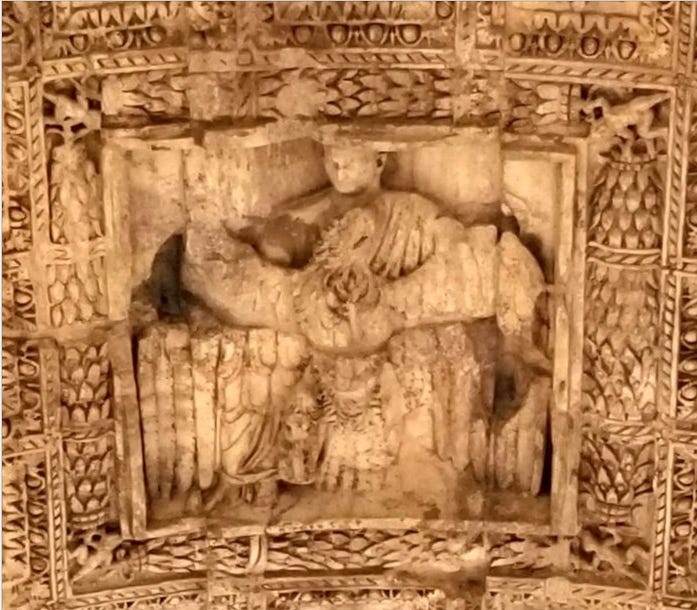
This process had a name, apotheosis, and the mythology of ancient Greece contains numerous instances of the deification of mortals. In the republican times of Greece, we find fewer examples of such deification. The people of Amphipolis offered sacrifices to the Spartan general Brasidas after his death (Thuc. V.11), and the people of Egeste built a shrine to Philippus and also offered sacrifices to him on account, apparently, of his beauty (Herod. V.47). In the kingdoms, which arose in the East on the collapse of the empire of Alexander, it appears to have been common for the successor to the throne to have offered divine honours to the former sovereign, such as the apotheosis of Ptolemy, king of Egypt.
Among the Romans, the term apotheosis signified the elevation of a deceased emperor to divine honours. This practice, which was usual upon the death of almost all of the emperors, at least the popular ones, appears to have risen from the belief that the souls or manes of their ancestors became spirits, and as it was common for children to pay reverance to the manes of their fathers, so it was natural for divine honours to be publicly paid to a deceased emperor, who was regarded as the father of his country.
This apotheosis of an emperor was usually called consecratio, and the emperor who received the honour of an apotheosis was said to be in deorum numerum referri, or ‘counted among the number of the gods’. Romulus is said to have been admitted to their number under the name of Quirinus (Plut. Rom. 27, 28), but none of the other Roman kings appears to have been given this honour, and in the republican times, there also appears to be no examples of such an apotheosis. Julius Caesar was deified after his death, and games were given in his honour by Augustus (Suet. Caes. 88); and so the precedent was set, followed in the case of the other emperors.
The ceremonies observed during an apotheosis are described by Herodian (IV.2):
“It is the custom of the Romans to deify those of their emperors who die, leaving successors; and this rite they call apotheosis. On this occasion, a semblance of mourning, combined with festival and religious observances, is visible throughout the city. The body of the dead they honour after human fashion, with a splendid funeral; and making a waxen image in all respects resembling him, they expose it to view in the vestibule of the palace, on a lofty ivory couch of great size, spread with cloth of gold. The figure is made pallid, like a sick man. During most of the day, senators sit around the bed on the left side, clothed in black, and noble women on the right, clothed in plain white garments, like mourners, wearing no gold or necklaces. These ceremonies continue for seven days, and the physicians severally approach the couch, and looking on the sick man, say that he grows worse and worse. And when they have made believe that he is dead, the noblest of the equestrian and chosen youths of the senatorial orders take up the couch, and bear it along the Via Sacra, and expose it in the old forum. Platforms like steps are built upon each side; on one of which stands a chorus of noble youths, and on the opposite, a chorus of women of high rank, who sing hymns and songs of praise to the deceased, modulated in a solemn and mournful strain. Afterwards, they bear the couch through the city to the Campus Martius, in the broadest part of which a square pile is constructed entirely of logs of timber of the largest size, in the shape of a chamber, filled with faggots, and on the outside adorned with hangings interwoven with gold and ivory images and pictures. Upon this, a similar but smaller chamber is built, with open doors and windows, and above it, a third and fourth, still diminishing to the top, so that one might compare it to the light-houses which are called Phari. In the second story, they place a bed, and collect all sorts of aromatics and incense, and every sort of fragrant fruit or herb or juice; for all cities, nations, and persons of eminence emulate each other in contributing these last gifts in honour of the emperor. And when a vast heap of aromatics is collected, there is a procession of horsemen and of chariots round the pile, with the drivers clothed in robes of office, and wearing masks made to resemble the most distinguished Roman generals and emperors. When all of this is done, the others set fire to it on every side, which easily catches hold of the faggots and aromatics; and from the highest and smallest story, as from a pinnacle, an eagle is let loose to mount into the sky as the fire ascends, which is believed by the Romans to carry the soul of the emperor from earth to heaven; and from that time he is worshipped with the other gods.”?
It was quite common to see medals struck in honour of an apotheosis, which depicted an altar with fire on it, and an eagle, the bird of Jupiter, taking flight into the air. From these medals alone, we can trace the tradition of an apotheosis from the time of Julius Caesar to that of Constantine the Great. On most of them, the word Consecratio occurs, and on some Greek coins, the word ΑΦΙΕΡΩϹΙϹ - ‘consecration’.
Whilst the ceremonies didn’t formally come with an attached biography, it was an important part of legacy-making to have the written life-story of the recently deceased emperor completed soon after death to help cement the transition.
If the recently deceased emperor was Claudius, and the author was Seneca the Younger, who famously hated the now dead ruler, mostly for having him exiled to Corsica for trying to sleep with his wife, then what resulted as a biography is one of the most famous and caustic slights in the history of Roman satire.
The Apocolocyntosis of Claudius, a play on the word ‘apotheosis’, anonymously written but almost certainly penned by Seneca, is short, funny, and utterly vicious. It imagines Claudius dying and being judged in the afterlife. Instead of deification, he is transformed into a vegetable.
‘Apocolocyntosis’ translates literally as ‘Pumpkinification’.
If tipping is your thing, your help covers research time, editing, and the occasional midnight cheese sandwich that fuels these posts. Thank you for keeping this space alive! Just click below to leave a tip

Paid subscribers get Acta Populi every Thursday, my private dispatch with behind-the-scenes research notes, archaeological finds, and the odd article even I wouldn’t dare put here. It’s $5/5/month or $50/year, and it also comes with my full translation of Suetonius’ Twelve Caesars as a welcome gift.
Join Acta Populi here
Since today’s article quoted directly from my book, you might want the whole thing: my complete translation of Suetonius’ The Twelve Caesars, two years of work, scandal and all. You can grab a copy on its own, or get it free as part of Acta Populi.
Another great article! I have the odd coin showing the pire of the consecratio of Antoninus Pius, deification is such a great topic in Roman state religion.
You might be interested in this rather unusual piece from the Prado Museum, which is traditionally known as the "Apotheosis of Claudius" for no good reason except when it was excavated in the 17th century some bright mind decided to add a bust of Claudius to the top. It seems instead to date back to the Augustan era.
https://www.museodelprado.es/coleccion/obra-de-arte/apoteosis-de-claudio/958d3902-a357-4aab-83c8-c8cde2a6635e