

Why Does Jesus Look Like That?


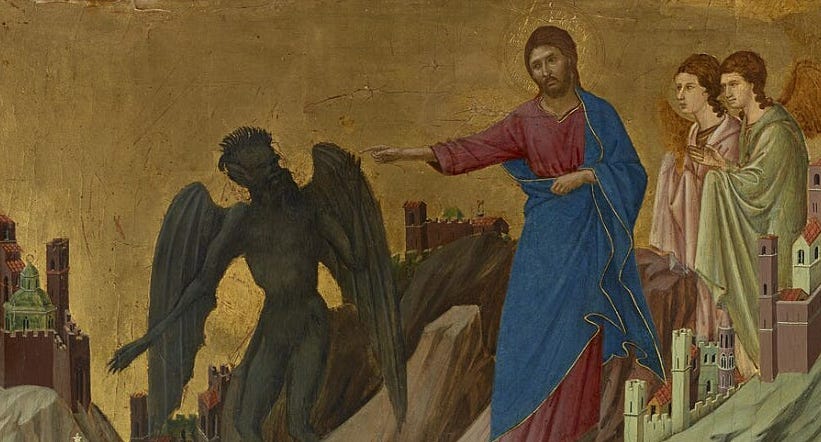
Firstly, I just want to make it clear that as someone who wrote their thesis on early Christian iconography, answering this question without rambling on into chapter after chapter of all sorts of tedious nonsense has required some quite brutal self-editing! I will try to answer the central question of “why that face” as succinctly as I can, and as such, there will be some avenues over which I skip quite freely.
Nobody, of course, sat down and decided that this was what Jesus definitely looked like and with good reason, too, because the New Testament gives us no clues as to what the living Jesus looked like. As a result, the face that stares out of a thousand icons, altarpieces, and cathedral windows is less a portrait and more a period convention that got frozen at a particular moment, replicated endlessly, and assumed to be something it never really was.
Very early Christian art broadly avoids the subject of what Jesus looked like altogether, and there are suggestions that the reason for this is given in the texts, no graven images and all that, but this is questionable. What seems more reasonable is that early depictions of Jesus refer more to him as an allegory than to attempts to represent what he looked like. Jonah being swallowed by the whale and disgorged three days later was a perfectly legible metaphor for the resurrection to anyone who knew the tradition. The Good Shepherd, a young man carrying a lamb across his shoulders, drew on both the twenty-third Psalm and a stock figure from Hellenistic pastoral art that had been doing iconographic heavy lifting long before Christianity existed. Orpheus taming the beasts served a similar function. Daniel in the lion’s den offered another. These images let Christians speak about Christ in a visual language that was recognisable, portable, and already available. More importantly, perhaps, it was deniable and so if any gruff-voiced Roman soldiers turned up, pointed at one’s image of Jesus on a catacomb wall and said: “’Ere.. who’s that then, you horrible little oik!?”, one could smile tamely and just say “That’s Daniel, sir, please don’t beat me, sir …”
Other early depictions, such as the famous Alexamenos graffito, are arguably not ‘Jesus’ at all, but a mocking figure linked to allegations of donkey worship, or a representation of someone’s ‘god’ made by one who really had no idea what he was trying to portray. It might also have meant to be Jesus himself, of course, but nobody ever thought Jesus looked like a donkey. So few of the very early images of Jesus are actually meant to look like him.
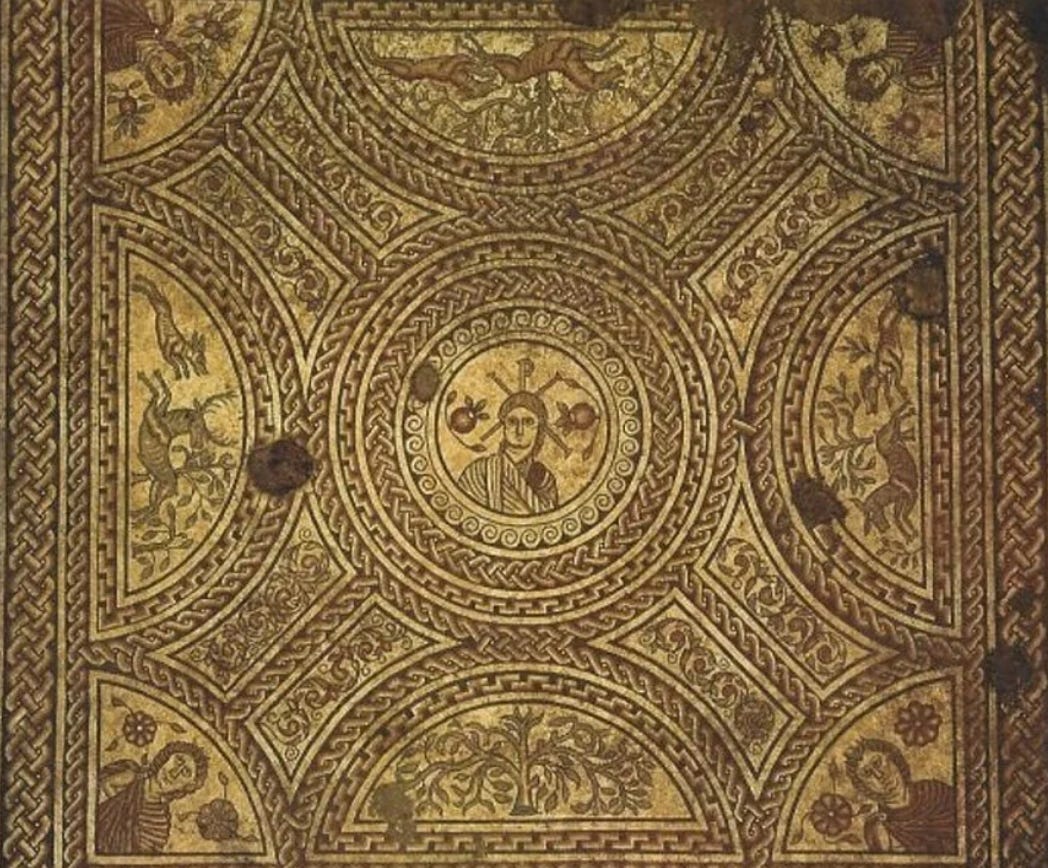
The earliest images, where one can begin to argue that the artists are trying to portray what he looked like, are notable because they look nothing like that face. The image from Dura-Europos in Syria, dating to around 235, shows a beardless young man, as does the Hinton St Mary mosaic from fourth-century Dorset, one of the most extraordinary objects to survive from Roman Britain, which has a central male figure flanked by pomegranates and backed by a chi-rho symbol. The arguments that the Hinton St Mary figure is Constantine are not particularly strong, but one interesting thing to note is that this figure is part of a much larger mosaic that includes all sorts of otherwise pagan imagery, such as Bellerophon and suggests a possibility that whilst the figure is Christ, the people who owned the mosaic were not necessarily Christians.
The Brescia Casket, from later in the fourth century, shows Christ moving through scenes of miracle and passion with a face as smooth as the ivory it is made from. The Maskell Passion Ivory, unambiguously showing a crucifixion, gives us a beardless Jesus on the cross, arguably the earliest image to do so.
The consistent detail across all of this early material is the absence of a beard, but this is not a theological or iconographical statement. More bluntly, it is a fashion statement. For much of the first three centuries of the Anno Domini era, the clean-shaven face was the dominant aesthetic in Roman culture, following the example set by the emperors from Augustus onward, with a brief wobble once Hadrian and his chums showed up. A bearded man looked Greek, or philosophical, or a barbarian, depending on context. Artists depicting an authoritative young male figure in this period made him smooth-faced because that was what authoritative young men tended to look like. Consuls, senators, emperors and other authoritarian figures in the Roman world in the middle of the first century AD, regardless of when the art itself was made, tended to be beardless, and what this imagery is trying to do is anchor Jesus specifically in that world.
All this takes a bit of a rocket once Constantine legitimised Christianity in 313. Subsequent imperial patronage of the church created a (relatively) overnight demand for Christian imagery at a scale that simply had not existed before. Christians began to worship more openly, and as such, they needed more churches. Churches need decoration, and wealthy Christians needed appropriate art for their sarcophagi, silverware and ivory diptychs. The newly liberated religion needed a visual language that could do the same work for Christ that the existing visual language did for the emperor. All of this is channelled through the paintbrushes and chisels of artists trained in late Roman and early Eastern stylistic conventions, and those conventions, by the fourth century, had shifted away from the beardless chap in the pallium and toga. Beards were back, baby! Partly, of course, under the influence of the portraiture of philosophical heavyweights like Marcus Aurelius, and partly as a meme of gravitas and authority. These images begin to arrive at a time when Western Roman society, in particular, is looking back a century or two to “happier times” and when influential figures could be more easily identified. We still do similar things today when slightly potty politicians try to evoke Napoleonic or World War II-type heroic imagery for themselves.
The result was that the first great firework burst of monumental Christian figural art depicted a bearded Christ, not because anyone had new information about what Jesus looked like, but because that was what a serious, weighty man looked like in the artistic movement of the day.
Once that template existed, it became self-perpetuating. Later artists looked back to the oldest authoritative examples they could find and discovered a whole raft of images produced in roughly the same part of the world in roughly the same period, all following the same stylistic conventions. The face looked consistent across these sources, not because they were independently recording something true, but because they all drew from the same artistic well.
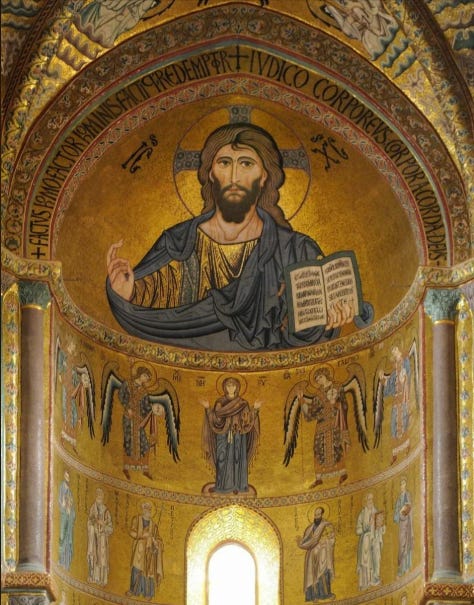
That same underlying template - bearded, long-haired, grave, direct-gazing - then gets processed through two different artistic and theological environments and produces two distinct iconic types that, between them, shaped most subsequent Western and Eastern imagery of Christ. The first is the Christ Pantocrator, a fundamentally Byzantine form. Pantocrator means “ruler of all,” and the image it names is immediately recognisable: a bust or half-figure, rigidly frontal, one hand raised in blessing, the other holding a Gospel book. The face is bearded and intense, the style deliberately hieratic rather than naturalistic. The Pantocrator doesn’t seem particularly concerned with the pettiness of humanity. It is an image of divine power rendered in a mode that rather flattens and abstracts any human qualities. God temporarily taking the form of man. The greatest surviving examples, such as the Christ Pantocrator mosaic at Cefalù in Sicily, or the one at Daphni near Athens, are a bit overwhelming because they are not portraits, and neither were they meant to be; they are dazzling, golden, theological, confrontational fanfares. Look at me and wonder, mortals!
The second type is the Christ in Majesty, the Maiestas Domini, which takes a different route. Here Christ is shown full-length, enthroned, normally surrounded by the four evangelists or their symbols, and taken from the visions of Ezekiel and Revelation. Such a composition is unmistakably imperial, with a seated ruler, frontal, in an attitude of authority, flanked by attendants. This is the formal presentation of the Roman emperor, translated into a religious setting. Again, the Brescia Casket, with Christ in a narrative frieze surrounded by other figures, already points toward this tradition and shows his authority as arising through the context of those around him. Pantocrator tends to show Jesus as the dazzling master of the universe, and Maiestas Domini shows him as the leader of men and the church. That one of these images goes on to form the basis of Jesus’ iconography in the east and the other in the west is obvious.
But both types use the same face, and it is just the framing that changes, which is actually decent evidence for the argument that this face is incidental rather than the point of any particular theological or political programme. It is, if you like, the face that was available at the time. If I were to show you 5 pencil portraits of a man drawn during five different decades of the twentieth century and ask you to decide which decade each was drawn in, you would have a pretty good chance of getting most of them right, because art tends to depict its own period, and those periods are identifiable through that art. A drawing of a man in his twenties from the 1960s is going to look very different from one of a man in his twenties from the 1910s.
So the image of Jesus was available material, a convention inherited from the fourth-century burst of image-making, which different traditions changed slightly according to their own needs. The Eastern church wanted an image of dazzling transcendence and stripped everything contingent away from the face. The Western church wanted an image of sovereignty and grafted the same face onto a bloke sitting on an imperial throne.
There are all sorts of other later traditions, such as Christ Triumphant, Christ in Judgment, the Man of Sorrows, and eventually the Renaissance naturalistic Christ, which are beyond our time period, but they all draw on the same face as a baseline, not because it represents an ideal of what Jesus looked like but, by that time, you didn’t have to explain to everyone who this bearded chap actually was. Everyone knew who he was instantly. One can do the same trick with other historical figures by adopting some motif of their iconography. Put on some Tudor clothes, and you’re a bloke in some Tudor clothes. Put on some Tudor clothes and stick a pillow up your jumper, and suddenly, you’re Henry VIII. Dress like a late Victorian/Edwardian gentleman, and you’re a late Victorian/Edwardian gentleman. Dress like a late Victorian/Edwardian with a deerstalker and a meerschaum, and suddenly, you’re Sherlock Holmes.
The Shroud of Turin is a great example of how this all works. You can look at all manner of scientific investigations into it and do all the C14 dating you want, but anyone with a knowledge of medieval art will look at the image of the man on it and instantly recognise that the face is consistent with fourteenth-century artistic conventions for depicting Christ in every aspect, from the proportions, the treatment of the beard, and the way the hair falls. It looks exactly like the way Jesus was supposed to look in about 1350. It’s subtly different to the way the bearded Jesus is depicted in Byzantine art or earlier medieval art, but it is as recognisably mid-fourteenth-century as those pencil drawings we talked about earlier are of their time period, too. Now, whether that means it was produced at that time or whoever made it was guided to reproduce the actual appearance of Jesus is another question entirely. But go back three hundred years, and Jesus didn’t look like that. Go forward three hundred years, and he looks different again. But all the while, the imagery carries the same visual vocabulary - an authoritative, benign, bearded chap in his thirties. The Shroud of Turin does capture an image of Christ, but it’s one from the time the thing was made, not from the time of Jesus.
The Bible, of course, is no help here at all, bless the old thing. The synoptic gospels have no interest in any sort of physical description. Isaiah 53:2 - “he had no form or majesty that we should look at him” - is sometimes pressed into service, but that passage is part of the Suffering Servant poem from Deutero-Isaiah, not a description of Jesus, per se, although it is used as a prophecy of Christ from very early on. Even if we accept that reading, it describes someone unremarkable in appearance, which is not quite what the iconographic tradition went on to produce, but perhaps is more to the point of who the actual Jesus was supposed to be - a humble man, not some devilishly handsome superhero.
Essentially, then, the face of Jesus is the face of a rather serious-looking chap in late Roman and early Byzantine art. It became the face of Jesus largely because it was the face available when Christian image-making first began to be scaled up, and every subsequent generation of artists looked back at what their predecessors had made and took it for a record of, or a suggestion of, something real. Not really an accident, more of an accumulation.
If you’ve been reading this newsletter for a while, you already know what the paid side looks like: longer, deeper, and occasionally in Latin. The paid articles go out every week, alongside a full translation and reader’s guide to the Historia Augusta, a text so strange and unreliable that it has occupied classicists for a century, and me for a decade, without resolution. If that sounds like your kind of thing, the subscription is $5/month. The link is below.
It’s $5/month (or $50/year), and you’ll also get a free copy of my translation of Suetonius’ Twelve Caesars as a welcome gift.
If this piece was worth your time, a $5 tip on Ko-fi is very welcome!

Suetonius is one of the main sources for the Roman emperors, but most modern readers never get through him.
Not because the material is difficult, but because the translations are.
My edition of The Twelve Caesars presents the text in clear modern English, restores what earlier editors removed, and explains the context as you go.
If you want to see what Rome actually looked like from the inside, this is the place to start. CLICK BELOW TO ORDER YOUR COPY!
Great article - thanks very much for sharing it.
LF